Ac Voltmeter Using Half Wave Rectifier

The DC level obtained from a sinusoidal input can be improved 100% using a process called full wave rectification. Although half wave rectifiers have some applications, the full wave rectifier is the most commonly used type in DC power supplies.
A full wave rectifier allows unidirectional (One-way) current through the load during the entire 360° of the input cycle, whereas a half wave rectifier allows current through the load only during one half of the cycle. The result of full wave rectification is an output voltage with a frequency twice the input frequency that pulsates every half cycle of the input.
The rectifier can be used before the multistage amplifier or after the amplifier. This depends on the type of amplifier used in AC voltmeter. If we are using multistage AC amplifier, then the rectifier circuit will be used after the amplifier. On the contrary, if the multistage amplifier used is DC, then the rectifier should be used before it. Half Wave Rectifier Mains power supply is applied at the primary of the step-down transformer. All the positive half cycles of the stepped down ac supply pass through the diode and all the negative half cycles get eliminated. The half wave rectifier is the simplest form of the rectifier. We use only a single diode to construct the half wave rectifier. The half wave rectifier is made up of an AC source, transformer (step-down), diode, and resistor (load). The diode is placed between the transformer and resistor (load).
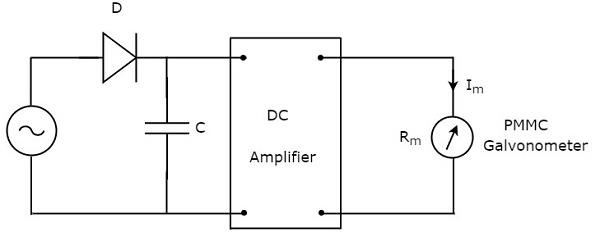
AC power line monitors use a simple half-wave rectifier to provide an economical AC voltmeter, which is calibrated to be accurate for sinusoidal signals around 115 or 230 Vac. Because of nonlinearity introduced by the rectified diode, the accuracy of power line monitors decreases away from the calibration point. In half wave rectifier only half cycle of applied AC voltage is used. Another half cycle of AC voltage (negative cycle) is not used. Only one diode is used which conducts during positive cycle. The circuit diagram of half wave rectifier without capacitor is shown in the following figure.
The number of positive alternations that make up the full wave rectified voltage is twice that of the half wave rectifier voltage for the same interval. The average value, which is the value measured on a DC voltmeter for a full wave rectified sinusoidal voltage is twice that of the half-wave rectifier.
VAVG = 2Vp/π
VAVG is approx 63.7% of Vp for a full wave rectified voltage.
Full wave rectifier are further classified into two types
- Center-Tapped Full Wave Rectifier
- Bridge Full Wave Rectifier
Center-Tapped Full Wave Rectifier
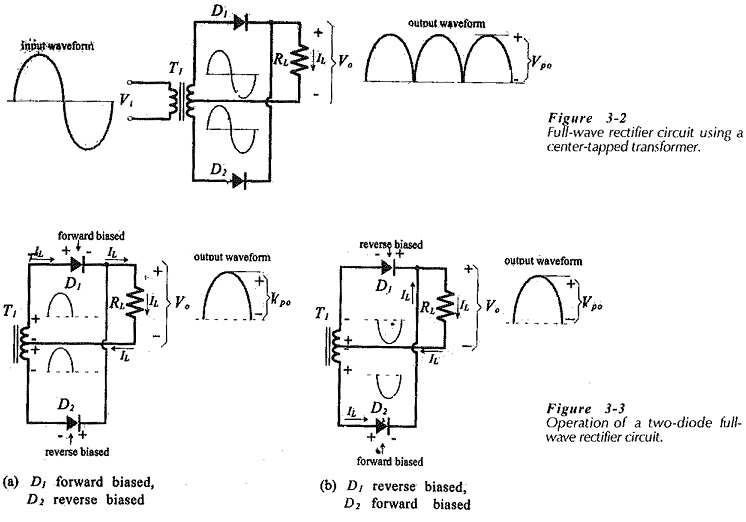
A center tapped rectifier is a type of full wave rectifier that uses two diodes connected to the secondary of a center tapped transformer. The input voltage is coupled through the transformer to the center tapped secondary. Half of the total secondary voltage appears between the center tap and each of the secondary winding.
For a positive half-cycle of the input voltage, the polarities of the secondary voltages as below:
In this condition D1 is forward-biased and D2 is reversed biased. The current path is through D1 and the load resistor RL as indicated.
For a negative half cycle of the input voltage, the voltage polarities on the secondary are as below:
Ac Voltmeter Using Half Wave Rectifier
In this condition D2 is forward-biased and D1 is reversed biased. The current path is through D2 and the load resistor RL as indicated.
As the output current is during both the positive and negative portion of the input cycle in the same direction through the load. The output voltage developed across the load resistor is a full wave rectified DC voltage.
Effect Of The Turns Ratio On Output Voltage
If the transformer’s turn ratio is 1, the peak value of the rectified output voltage equals half the peak value of the primary input voltage less the barrier potential. Half of the primary voltage appears across each half of the secondary winding (Vp(sec) = Vp(pri)). In order to obtain an output voltage with a peak equal to the input peak, a step-up transformer with a turns ratio of n=2 must be used. The total voltage across transformer secondary coil is twice the primary voltage (2Vpri), so the voltage across each half of the secondary is equal to Vpri.
In any case, the output voltage of a center-tapped full wave rectifier is always one half of the total secondary voltage less the diode drop, no matter what the turn ratio.
Vout = (Vsec/2) -0.7 V
Peak Inverse Voltage (PIV)
Each diode in the full wave rectifier is alternately forward-biased and then reverse-biased. The maximum reverse voltage that each diode must withstand is the peak secondary voltage Vp(sec) .
Full Wave Bridge Rectifier
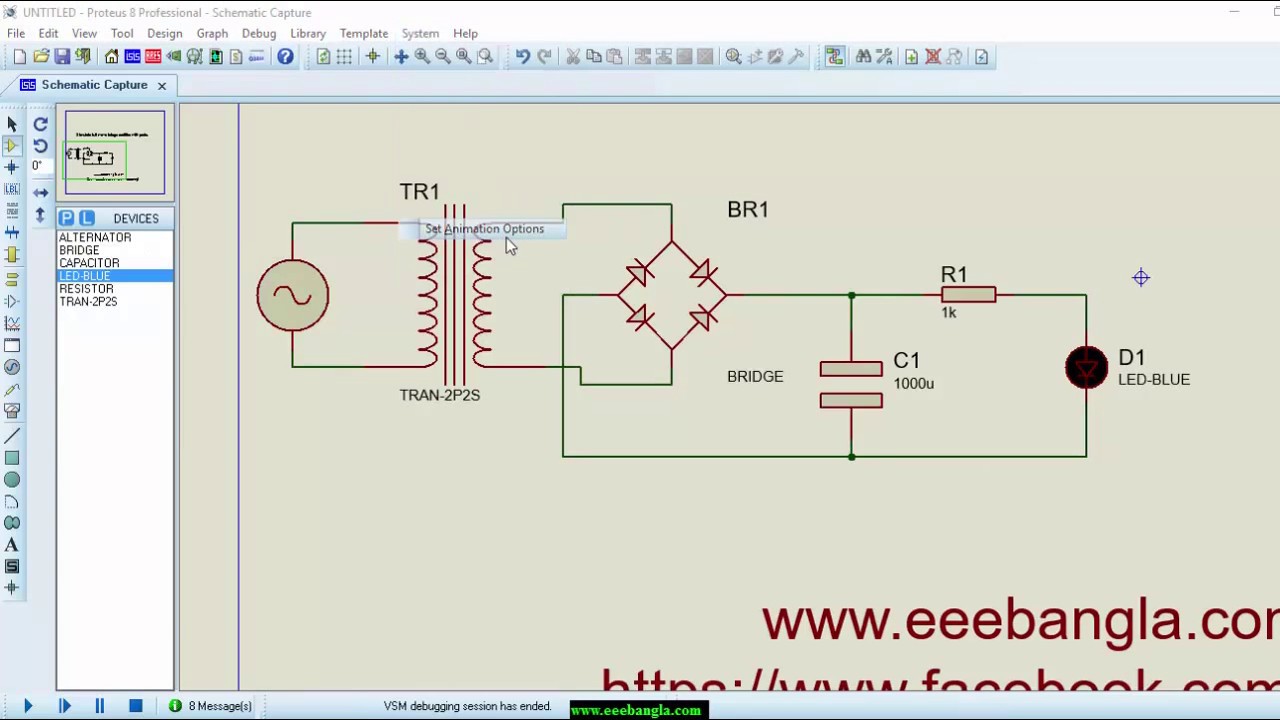
The bridge rectifier uses four diode connected as shown below:
When the input cycle is positive D2 and D4 are forward biased and conduct current. A voltage is developed across RL that looks like the positive half of the input cycle. During this time D1 and D3 are reverse biased.
When the input cycle is negative, diode D1 and D3 are forward biased and conduct current. A voltage is developed across RL that looks like the positive half cycle. During the negative half cycle D2 and D4 are reversed biased.
A full wave rectified output voltage appears across RL as a result of this action.
Bridge Output Voltage
During the positive half cycle of the total secondary voltage, diode D2 and D4 are forward biased. Neglecting the diode drops, the secondary voltage appears across the load resistor. The same is true when D1 and D3 are forward-biased during the negative half cycle.
Vp(out) = Vp(sec)
As, two diodes are always in series with the load resistor during both the positive and negative half cycles. If these diode drops are considered, the output voltage is
Vp(out) = Vp(sec) – 1.4 V
Peak Inverse Voltage (PIV)
The PIV of each diode (ideal) is obtained at the peak of the positive region of the input signal. For the indicated loop the maximum voltage across R is Vm and the PIV rating is defined as:
PIV = Vp(out)
In Half Wave Rectifier, when the AC supply is applied at the input, a positive half cycle appears across the load, whereas the negative half cycle is suppressed. This can be done by using the semiconductor PN junction diode. The diode allows the current to flow only in one direction. Thus, converts the AC voltage into DC voltage.
Circuit Diagram of Half Wave Rectifier
In half-wave rectification, only one crystal diode is used. It is connected in the circuit as shown below.
The AC supply to be rectified is generally given through a transformer. The transformer is used to step down or step up the main supply voltage as per the requirement. It also isolates the rectifier from power lines and thus reduces the risk of electric shock.
Operation of Half Wave Rectifier
When AC supply is switched ON the alternating voltage (Vin) shown in the figure below appears across the terminal AB at the secondary winding.
During the positive half cycle, terminal A is positive with respect to B and the crystal diode is forward biased. Therefore, it conducts and current flows through the load resistor RL. This current varies in magnitude as shown in the wave diagram shown below.
Thus, a positive half cycle of the output voltage (Vout = iRL) appears across the load resistor RL shown in the figure below.
Peak Inverse Voltage
Ac Voltmeter Using Half Wave Rectifier Circuits
During the negative half-cycle when the diode is reverse biased the maximum value of the voltage coming across the diode is called the peak inverse voltage. As the current flows through the load resistor RL, only in one direction, i.e., from M to L. Hence, a DC output is obtained across RL, which is pulsating in nature.
Disadvantages of the Half Wave Rectifier
The disadvantages of the half-wave rectifier are as follows:
- The output is low because the AC supply delivers power only half of the time.
- The output contains more alternating component (ripples). Therefore, it needs a heavy filter circuit to smooth out the output.
Full Wave Rectifier
In Full Wave Rectification, when the AC supply is applied at the input, during both the half-cycles (i.e., positive as well as negative) current flows through the load in the same direction. This can be achieved by using two crystal diodes. The two diodes conduct the current alternately.
To obtain the same direction of flow of current in the load resistors RL during positive as well as the negative half cycle of input, the two circuits are used. They are named as follows:-
To have detailed explanation on the two types of full wave rectifiers follow the links given above.
Related terms: